How compilers work
A single primary server can process requests and compile code for up to 4,000 nodes. When you exceed this scale, expand your infrastructure by adding compilers to share the workload and compile catalogs faster.
Compilers act as PCP brokers, conveying messages between
the orchestrator and Puppet Execution Protocol (PXP) agents. PXP agents connect to PCP
brokers running on compilers over port 8142. Status checks on compilers must be sent to
port 8140, using https://<hostname>:8140/status/v1/simple.
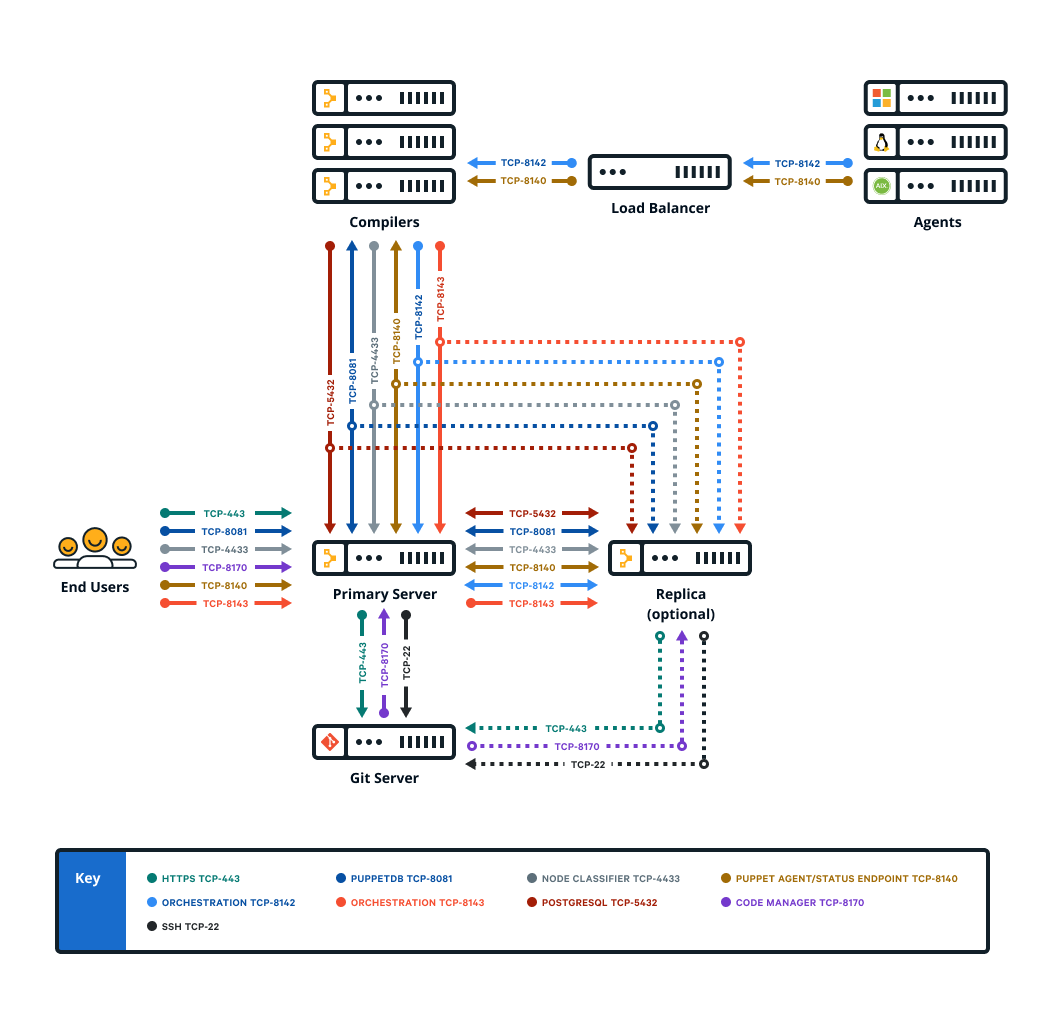
Components and services running on compilers
Compilers typically run Puppet Server and PuppetDB services, as well as a file sync client. Older, legacy-style compilers must be converted in order to add PuppetDB.
When triggered by a web endpoint, file sync takes changes from the working directory on the primary server and deploys the code to a live code directory. File sync then deploys that code to all your compilers. By default, compilers check for code updates every five seconds.
The certificate authority (CA) service is disabled on compilers. A proxy service running on the compiler Puppet Server directs CA requests to the primary server, which hosts the CA in default installations.
Compilers also have:
- The repository for agent installation,
pe_repo - The controller profile used with PE client tools
- Puppet Communications Protocol (PCP) brokers to enable orchestrator scale
Logs for compilers are located at
/var/log/puppetlabs/puppetserver/.
Logs for PCP brokers on compilers are located at
/var/log/puppetlabs/puppetserver/pcp-broker.log. Logback
configuration for PCP broker logs is part of the Orchestration services settings .


